In Conversation with Dr. Quarraisha Abdool Karim
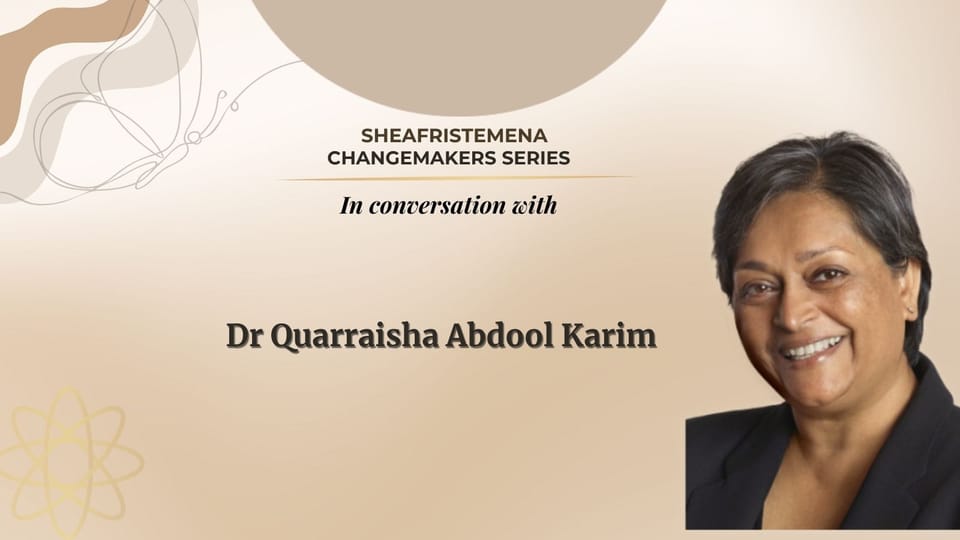
There are scientists who build knowledge — and there are those who build hope.
Dr. Quarraisha Abdool Karim has spent her life doing both.
A pioneering South African epidemiologist and one of the world’s most influential voices in global health, Dr. Abdool Karim has not only advanced the frontiers of HIV research but reimagined what science itself can be: compassionate, inclusive, and just. Her story is not only that of a brilliant researcher, but of a woman who has expanded the boundaries of what is possible — for millions of others, and for the generations who follow.
For more than three decades, she has worked at the intersection of research, policy, and equity, translating data into dignity and science into social justice. At the helm of the Centre for the AIDS Programme of Research in South Africa (CAPRISA), she led the groundbreaking study that gave women — for the first time — the power to protect themselves from HIV infection. It was a scientific milestone, yes, but it was also something more profound: an act of liberation.
Her work has reshaped not only the fight against HIV, but the global understanding of how science must serve those most affected. Beyond the laboratory, she has become a mentor, a visionary, and an architect of hope — a scientist whose empathy is as vast as her intellect.
Through her voice, women scientists across Africa and the Global South have found both representation and inspiration. In her leadership, she embodies a truth that resonates far beyond academia: that science is not simply the pursuit of discovery, but the practice of humanity.
We are deeply grateful to Dr. Abdool Karim for taking the time to speak with SheAfriSTEMENA, and for supporting a small initiative dedicated to amplifying the stories of women who, like her, are transforming the world — one breakthrough at a time.
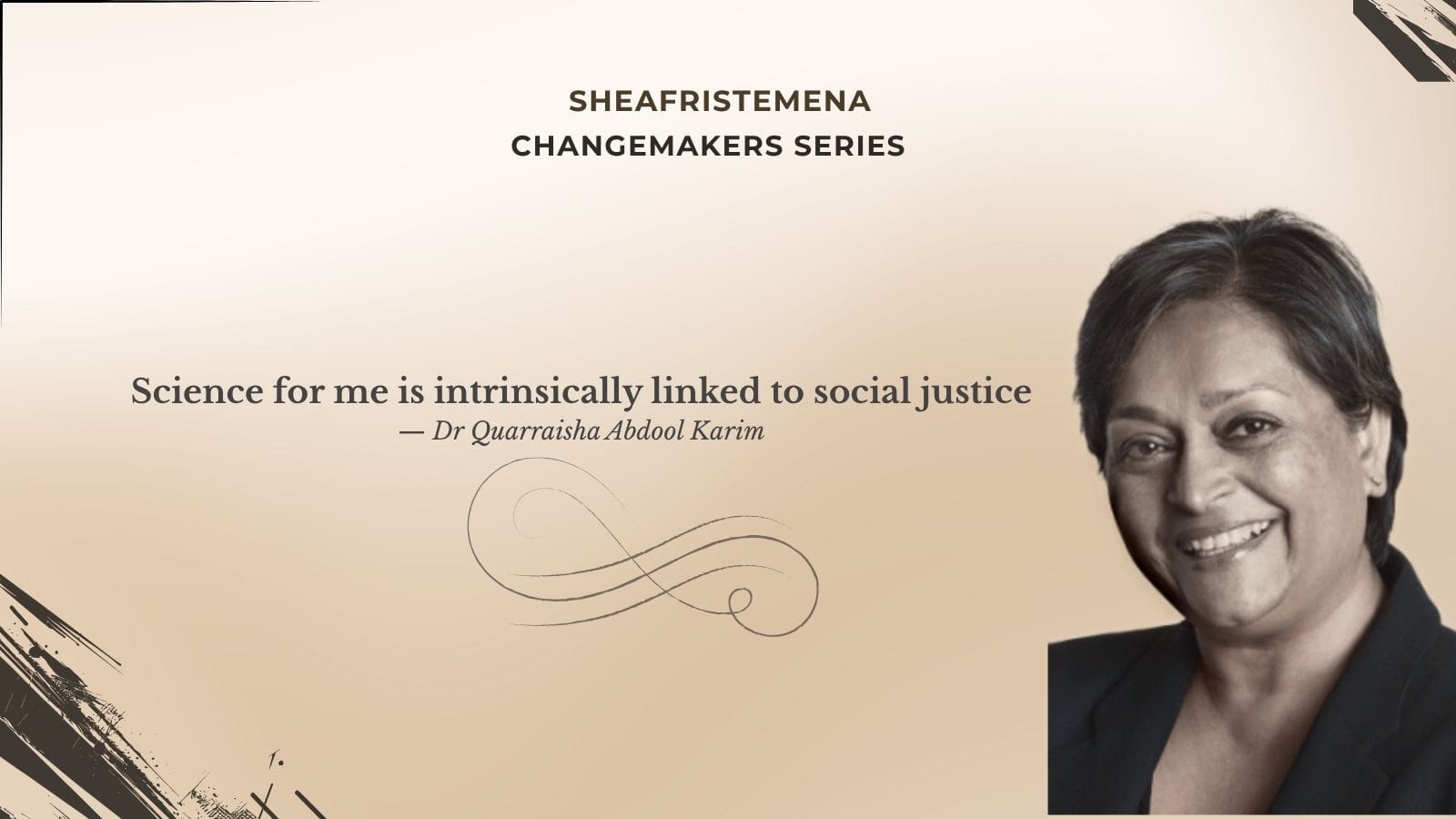
For Dr. Quarraisha Abdool Karim, science has never been separate from justice — and that belief runs through every part of her journey. In this special SheAfriSTEMENA Changemakers Conversation, she reflects on equity, leadership, and the evolving role of women in science across Africa and the Global South. Her words remind us that discovery alone is not enough; it must serve humanity, open doors, and inspire those who follow.
In Conversation with Dr. Quarraisha Abdool Karim
Beginnings and Motivation
Looking back on your early life and career, was there a pivotal moment or experience that not only drew you into HIV/AIDS epidemiology but also made you realize the human impact this work could have on African communities?
In 1988, when I was doing my Master's in Parasitology at the School of Public Health, at Columbia University, the dominant discourse on campus and in the city was AIDS. Returning to South Africa, in late 1988, I was very surprised that there so little data on AIDS in southern Africa? My husband, Salim Abdool Karim and I undertook one of the earliest population-based surveys in our home province of KwaZulu-Natal between 1989-1990. The data were very clear; an overall prevalence of <1%. But, what surprised us was the age-sex difference in who was getting infected when - young women 15-24 years had about 6 times more HIV infection compared to their male peers and in contrast men were acquiring HIV 5-7 years later, in their mid-20s compared to young women. The subsequent socio-epidemiological studies highlighted a major gap between who was bearing a disproportionate burden of HIV and what was available to prevent HIV infection – and so began our quest to find a prevention technology that women can use.
Groundbreaking Research
Your research on microbicides and HIV prevention has been described as a game-changer for women’s health. Could you share a moment — perhaps a breakthrough or even a setback — when you felt the weight of how your work could change lives?
One of the most powerful moments in my career was sharing the results of the CAPRISA 004 trial at the International AIDS Conference in Vienna in July 2010 and published simultaneously in the journal Science. This study demonstrated for the first time that antiretroviral drugs could prevent HIV infection in women and laid the foundation of what is today referred to as pre-exposure prophylaxis or PrEP and widely available in over 100 countries as a daily, oral tablet. For years, we had faced skepticism, failed attempts, and limited prevention options for women. I vividly remember the day we confirmed those results—it felt like a weight had lifted. For the first time, women had a method they could use discreetly, without negotiating with a partner. But the journey was anything but straightforward. Behind that moment were years of disappointments, countless community consultations, and resilience in the face of doubt. That breakthrough taught me that real change is rarely a single moment of success; it is the cumulative result of perseverance, persistence, and the courage to keep trying despite setbacks.
Science, Policy, and Responsibility
Leading at the intersection of science and public health policy often comes with tough decisions. How have you balanced scientific evidence, political realities, and ethical responsibilities when shaping health strategies?
Balancing science, politics, and ethics has always been one of the more challenging parts of my work. Public health decisions are rarely made in a vacuum—they intersect with economics, politics, and social realities. For me, the guiding principle has been that evidence must serve people, particularly those who are most vulnerable. This means pushing staying focused on the priority research questions, engaging communities, potential beneficiaries and key stakeholders early on in the process and throughout to ensure that findings don’t remain buried in academic journals or conference presentations but reach policymakers and communities in a way that translates into practical action. This requires courage and commitment but always focus on what you are trying to achieve and who ultimately benefits from the science. Communities must remain at the heart of decision-making, otherwise the science risks becoming irrelevant.
Women in Global Health Leadership
Women scientists, especially in Africa, still face barriers in reaching leadership positions. If you could change one structural obstacle tomorrow to open doors for women in science and health policy, what would it be and why?
If I could change one structural obstacle tomorrow, it would be how leadership itself is defined and recognized. Too often, the systems that determine who is seen as a “leader” in science and health is shaped by patriarchal norms—rewarding visibility, titles, and institutional prestige over the quiet, sustained work of building communities, mentoring teams, and strengthening systems. Women are frequently doing the latter, but it is undervalued and rarely rewarded with the same recognition as their male counterparts. What we need is a redefinition of leadership that embraces collaboration, nurtures diverse contributions, and values impact as much as visibility. Once we broaden what leadership looks like, more women will not only have a seat at the table but will also have their contributions acknowledged for what they truly are: transformative. Changing that structure would open doors for many more women in Africa and globally to thrive in science and health policy. Indeed it is a luxury, given the complex challenges that face us, not to do so. Even with this investment, the results are not seen overnight—it is a long, intentional process of nurturing women scientists and then once you have a seat at the table, own it by doing excellent science in service to humanity.
Mentorship and Legacy
You’ve mentored countless scientists and leaders. Beyond research skills, what personal values or leadership qualities do you believe are essential for the next generation of African women scientists?
I have benefitted immensely from several generous mentors over my lifetime who have taught me and guided me on the value of impactful research that I share with scientists I mentor. It revolves around three P’s: passion, perseverance, and the pursuit of excellence. Passion is what sustains you when the work feels overwhelming. Research is often long, slow, and filled with uncertainty; without passion, it is difficult to remain committed. Perseverance is equally vital, because failure is not the exception—it is the norm. The greatest discoveries often come after repeated setbacks. Finally, the pursuit of excellence is what allows scientists to stand out and make a lasting impact. Mediocrity has no place in science. Alongside these values, I encourage empathy, curiosity, and collaboration. Science thrives when we build bridges across disciplines, communities, and countries.
Epidemics and Future Preparedness
From HIV/AIDS to COVID-19, Africa has faced some of the world’s most pressing health challenges. What key lessons in preparedness and resilience must the world embrace to prevent repeating the same mistakes in the next pandemic?
The Covid-19 pandemic highlighted our interconnectedness and shared vulnerabilities but it also underscored the huge divides between industrialized and low- and middle-income countries, among others, in terms of manufacturing capacity, research capabilities, investments in science and access to affordable biotechnologies. On the one hand, it was super exciting to see how the decades of investment in research infrastructure and in training of scientists in HIV and TB diagnostics and the conduct of treatment and prevention trials enabled Africa to rapidly pivot to develop the diagnostics, identify variants of concern, guide national responses, and undertake vaccine and treatment trials, giving us the unprecedented six vaccines in less than a year. The lesson is clear: preparedness cannot be reactive. It must be built into health systems, scientific institutions, and international cooperation long before a crisis arrives. Equity must be a cornerstone, otherwise we risk repeating the same mistakes we saw with Covid-19 with devastating consequences.
Collaboration and Equity
Your career has involved global collaboration. How do we ensure that African voices and expertise are not just included but truly centered in international health partnerships?
For Africa to be truly centered in global collaborations, African scientists need to lead the science to address local challenges and not be mere implementors or participants of multi-centre studies conceived and developed in industrialized countries. Too often, we see extractive models where data and samples leave the continent but the benefits—be they publications, patents, access or policy influence—are concentrated elsewhere. This is not collaboration or partnership; it is exploitation and the betrayal of the trust of volunteers who participate in the research. True partnership means African scientists co-leading studies, setting research agendas, sharing the risks and having equal say in how outcomes are shared and made available and accessible to the beneficiaries of that research. HIV has shown us what solidarity can achieve—activism, science, political commitment, and donor investments accelerated drug affordability and access, mobilized resources, and transformed the face of AIDS from an inevitably fatal condition to one that is chronic and manageable. That same spirit must guide partnerships across all areas of science. Our survival and prosperity as a global community depends on our ability to work together to build inclusive and equitable science systems at individual, institutional, national, regional, and global levels.
Balancing Purpose and Pressure
The demands of science, leadership, and advocacy can be overwhelming. What personal practices or mindsets have sustained you through moments of pressure, uncertainty, or public scrutiny?
The demands of science, leadership, and advocacy can be overwhelming, and there have been moments of intense scrutiny and pressure. What sustains me is remembering why I do this work. When I meet women in rural and urban communities who participate in our studies, or when I see the tangible impact of research translated into policy, I am reminded that science is not abstract—it is about people’s lives. I also try to remain grounded in the idea that science is intrinsically linked to social justice. That perspective helps me navigate uncertainty and reminds me that the ultimate measure of success is not recognition or awards, but whether the science has improved people’s well-being.
Vision for 2040
If you imagine the world of public health in 2040, what progress do you hope your life’s work will have contributed to — especially for women and young scientists in Africa?
Science for me is intrinsically linked to social justice. And that is a guiding barometer for the work we do at CAPRISA. Science for the benefit of all. So while science advice is increasingly being sought by politicians for evidence-based policymaking, the parallel infodemic of mis- and dis-information has also reminded us, as scientists, of the need to pay more attention to how we communicate science to the public. For science to benefit everyone everywhere, we need to build resilient scientific institutions for addressing challenges for today and tomorrow and we need to generate knowledge that unites rather than divides. By 2040, I hope we will have built health systems in Africa that are resilient, equitable, and prepared for whatever new challenges emerge. HIV may remain part of that landscape, but my real vision is that its lessons will have transformed how we think about public health—placing prevention, equity, and community engagement at the center. I would like to see a generation of scientists across Africa who no longer have to fight for recognition, because their contributions are integral to how global health operates. For young African women in particular, I hope science will not be the exception or an ongoing battle but a natural career path, supported by structures that value their ideas, their leadership, and their voices. If, by 2040, Africa is not just participating in global health conversations but driving them, then I believe the sacrifices and struggles of this generation of scientists will have been worthwhile. My dream is to live in a world where everybody, no matter where they are born, has the ability to reach their full potential in their best skill sets, for their superpowers to be realized.
Women in STEM Careers
Your journey has inspired many young African women to pursue STEM careers. What do you see as the biggest barriers preventing girls from entering science and research, and what solutions have proven most effective in breaking them down?
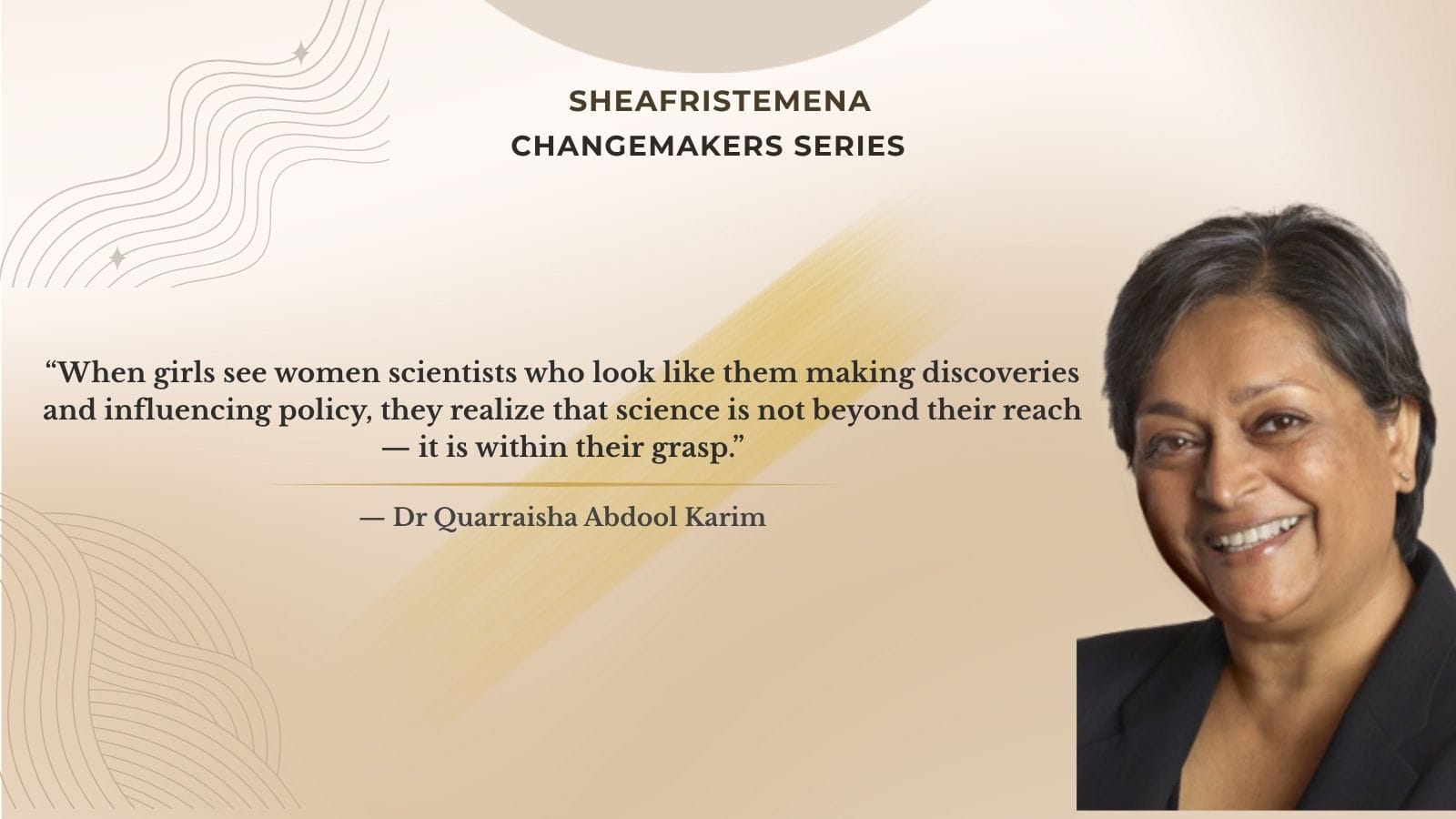
The greatest barriers preventing young girls in Africa from pursuing STEM careers are deeply rooted in poverty, gender inequality, and social expectations. Many girls face pressure to leave school early, assume caregiving roles, or accept limited opportunities. For them, even imagining a career in science can feel like an unattainable dream. Solutions must be multi-layered: strengthening education systems, providing mentorship, addressing gender-based violence, and offering financial support. But equally important is creating visible role models. When girls see women scientists who look like them making discoveries and influencing policy, it helps them realize that science is not beyond their reach—it is within their grasp. My dream is to live in a world where everybody, no matter where they are born or their sex or gender, has the ability to reach their full potential and for their superpowers to be realized.
Building Africa’s Research Capacity
From your experience leading research and public health initiatives, what investments or policies do you believe are critical to create a thriving, inclusive STEM ecosystem in Africa for the next generation of scientists?
My lived experience of growing up in apartheid South Africa, has had a profound effect on how I see my role as a scientist. As a young anti-apartheid activist involved in the daily struggle for freedom, human rights and justice, I know the importance of human dignity and inclusiveness in all facets of life including in my scientific endeavours. In a world of asymmetry, where knowledge generation and the benefits of technological advances remain unevenly distributed, science can be a transcendental force, building bridges across divides. It can help ensure that the future does not leave entire populations behind. Building a thriving research ecosystem in Africa requires more than individual excellence; it requires ongoing investment. This means governments prioritizing research in national budgets, private sector investment in innovation, and international funders supporting long-term institutional development, not just short-term projects. It needs informed societies who co-own and value knowledge generation and believe in and trust science as our hope for a better world. Policies must reward collaboration, transparency, and inclusion, rather than dependency on outside expertise. Science diplomacy is essential here: it has the power to bridge divides, build trust across nations, and ensure that Africa is not left behind as new technologies reshape the world. A strong, inclusive African research system is not just good for Africa—it is essential for global health security.
At SheAfriSTEMENA, we honour Dr. Quarraisha Abdool Karim not only for the brilliance of her science, but for the grace, courage, and conviction with which she has carried it. Her voice continues to open doors for women across Africa and the MENA region — and her legacy reminds us that science, at its best, is an act of love and justice. This is our way of giving her flowers — in gratitude, admiration, and endless respect.
This feature is part of the SheAfriSTEMENA Changemakers Series — celebrating women scientists and innovators shaping Africa’s and the MENA region’s scientific future. Join us as we continue to share their voices, stories, and impact at sheafristemena@gmail.com www.sheafristemena.com.